

Introduction
The ASTM D71581 Standard provides a method to classify asphalt shingles for wind resistance by conducting a two-part assessment: (1) determining wind uplift pressure coefficients and (2) determining the uplift resistance of the asphalt shingle sealant strip. The first part involves testing to determine wind uplift pressure coefficients acting on shingles under the action of simulated wind flow over a roof surface. This test uses pressure taps and methodologies consistent with wind tunnel testing. Using the tested uplift pressure coefficients, uplift forces (wind loads) acting on roof shingle sealant strips are determined in accordance with ASCE 72 wind design principles. For standardized conditions3, these forces are determined for three basic wind speed values and used to assign a shingle “class” for specification and code compliance. The classes are associated with the following design wind speeds (based on 3-second gusts):4
Class D – basic wind speed of ≤ 116 mph (Vult, 3-sec gust)
Class G – basic wind speed of ≤ 155 mph (Vult, 3-sec gust)
Class H – basic wind speed of ≤ 194 mph (Vult, 3-sec gust)
The second part of the ASTM D7158 assessment focuses on the uplift resistance of shingle sealant strips, which is paramount for keeping the shingle system intact when wind tries to lift shingles and initiate roof system failure. The tested uplift resistance is compared to the uplift force (wind load) associated with each shingle class determined as described above for standardized conditions. The shingle is assigned to a specific wind resistance class (e.g., Class D, G, or H) where its average measured uplift resistance is equal to or greater than the calculated wind force for a given shingle class and its associated wind speed. Adequate performance of the sealant strip ensures that the shingle installation performs as an integrated system to resist wind loads. To complete the uplift load path through the shingle system, mechanical fastening of shingles to the roof deck is provided in accordance with manufacturer installation instructions.
Starting with the 2010 edition, the ASCE 7 standard uses “ultimate” wind speeds (Vult) in their design wind speed maps. These speeds are associated with extreme wind events (return periods vary by a building’s Risk Category5). Because the ASTM D7158 methodology uses these ultimate wind speeds, there is no need to apply an additional safety factor to the tested shingle resistance values. An Allowable Stress Design (ASD) factor of safety of 1.67 is implicitly provided by use of an unfactored ultimate wind load (force) and use of an unfactored average shingle resistance (i.e., resistance factor of 1.0). This level of safety (or functional performance objective for asphalt shingles) is more conservative than a typical safety factor of 1.5 used for many building components, such as cladding and fenestration, which usually are based on as few as one to three proof tests to characterize a reference resistance value. Also, it is consistent with a 1.67 safety factor traditionally used for evaluation of whole building overturning resistance. For more information on the performance basis of the ASTM D7158 Standard, refer to Sections X1.5 and X1.6 of ASTM D7158.1
Application of ASTM D7158 for Non-standard Conditions
To this point, the discussion has addressed background information for typical uses of ASTM D7158 to evaluate, classify, and specify shingles for standard conditions of use. But what if the standard conditions do not apply to a specific project? This guide addresses the use of ASTM D7158 when one or more of the following non-standard conditions occur:
- The basic design wind speed is greater than 194 mph (exceeds the wind speed limit established for a Class H shingle),
- The building site is in a wind exposure D condition,
- The building site is subject to topographic conditions resulting in wind speed up effects, or
- The mean roof height exceeds 60 feet.
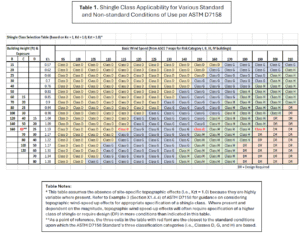
Because the ASTM D7158 Standard’s method of classifying shingles is based on wind engineering principles of ASCE 7, shingle classification results can be mathematically scaled to match the actual wind loads experienced in diverse, real-world building scenarios and wind conditions. Such scaling has been done in Table 1, which provides guidance for conditions that differ from the standard conditions used by ASTM D7158. Use of Table 1 does not require any additional analysis or re-evaluation of shingles since the shingles are consistent with the ASTM D7158 methodology. As a point of reference, the three cells in the table with red font are the closest to the standard conditions upon which the ASTM D7158 Standard’s three classification categories (i.e., Classes D, G, and H) are based.
Where “DR” (design required) is indicated in Table 1, a design is required and should follow the examples provided in Appendix X1 of ASTM D7158 (Section X1.4) to determine the force that the shingle must resist in accordance with Section 12 of the Standard. However, because the shingle wind load and sealant strip forces will be greater than those associated with the highest class (Class H) covered by the Standard, the shim thickness used to determine the uplift pressure coefficients (DCp) for the shingle in accordance with Section 11.2 may need to be increased depending on the rigidity (EI) of the shingle determined in accordance with Section 11.1 of the standard. Consequently, the conditions identified as “DR” in Table 1 may require retesting of the shingle product to determine acceptability for these non-standard conditions that correspond to shingle wind loads, sealant strip forces, shingle deflections that are greater than those addressed by the Standard. Consult with the shingle manufacturer when faced with design conditions identified in Table 1 as “DR”.
1 ASTM D7158 / D7158M-24a, Standard Test Method for Wind Resistance of Asphalt Shingles (Uplift Force/Uplift Resistance Method), ASTM International, www.astm.org.
2 ASCE 7-22, Minimum Design Loads and Associated Criteria for Buildings and Other Structures, American Society of Civil Engineers, Reston, VA, www.asce.org.
3 In accordance with ASTM D7158 Section 6.3, standardized conditions for the shingle classes are as follows:
(1) The ASCE 7 mapped basic wind speed (3 s gust) for a given building risk category does not exceed the basic wind speed associated with the applicable shingle class;
(2) The wind exposure category is B or C;
(3) The mean roof height does not exceed 60 ft; and
(4) There are no topographic wind speed up effects.
4 For code requirements related to specification of asphalt shingle classes, refer to Section 1504.2 of the 2024 IBC and Section R905.2.4.1 of the 2024 IRC.
5 The return periods for ASCE 7 mapped basic wind speeds and building risk categories (RC) are as follows:
- RC I (low risk to life): 300 years
- RC II (e.g., homes, offices, retail): 700 years
- RC III (buildings with substantial life or economic risk potential): 1,700 years
- RC IV (essential facilities having substantial community impact): 3,000 years
DISCLAIMER OF LIABILITY: This document was prepared by the Asphalt Roofing Manufacturers Association and is disseminated for informational purposes only. Nothing contained herein is intended to revoke or change the requirements or specifications of the individual roofing material manufacturers or local, state and federal building officials that have jurisdiction in your area. Any question, or inquiry, as to the requirements or specifications of a manufacturer, should be directed to the roofing manufacturer concerned. THE USER IS RESPONSIBLE FOR ASSURING COMPLIANCE WITH ALL APPLICABLE LAWS AND REGULATIONS.
Nothing contained herein shall be interpreted as a warranty by ARMA, either express or implied, including but not limited to the implied warranties of merchantability, fitness for a particular purpose or non-infringement. IN NO EVENT SHALL ARMA BE LIABLE FOR ANY DAMAGES WHATSOEVER, including special, indirect, consequential or incidental damages or damages for loss of profits, revenue, use or data, whether claimed in contract, tort or otherwise. Where exclusion of implied warranties is not allowed, ARMA’s liability shall be limited to the minimum scope and period permitted by law.
